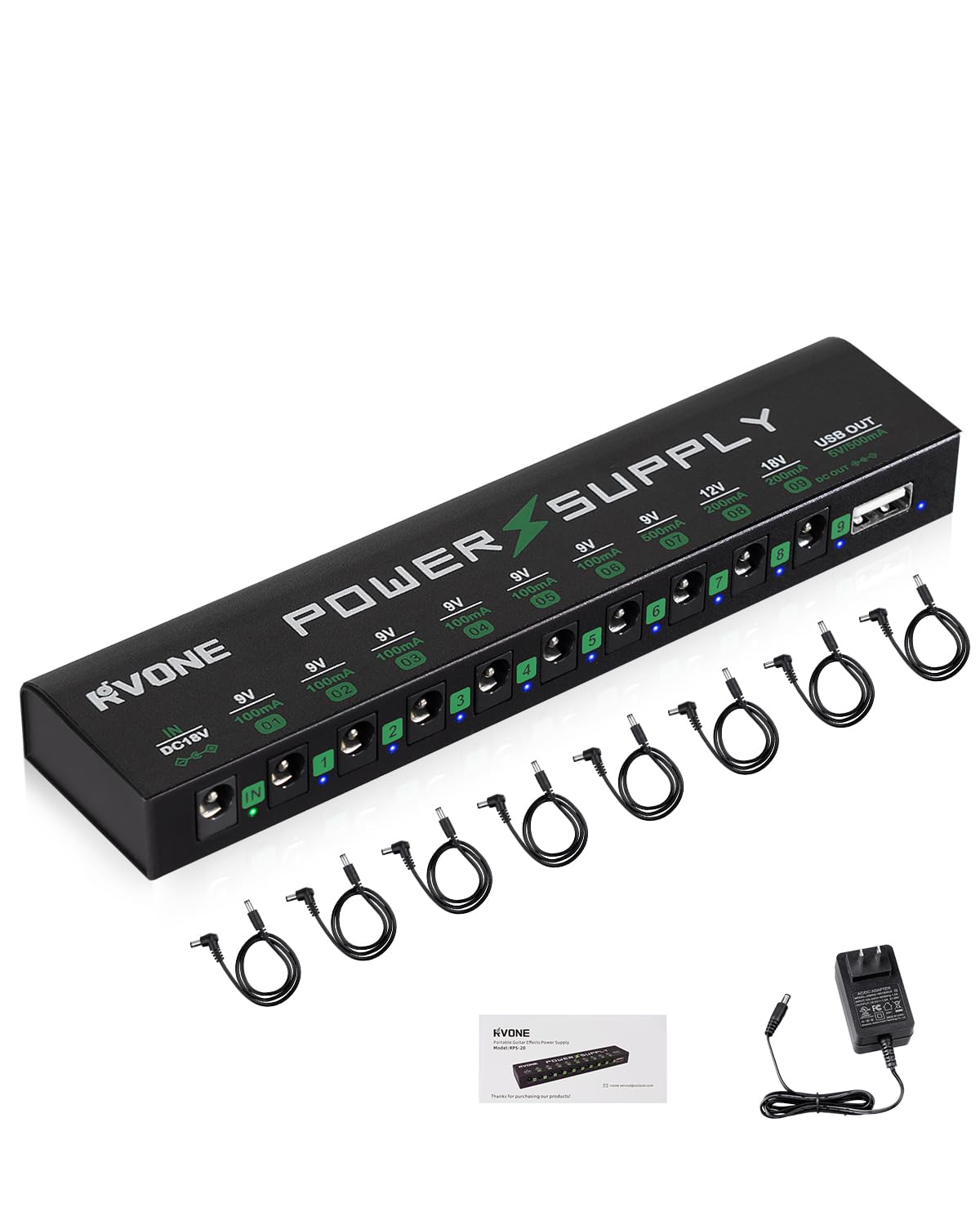
Power is one of the single biggest factors that shapes how your pedals sound and behave. If you use multiple pedals, especially digital or high-current units, a cheap daisy-chain or mismatched adapters can introduce hum, tone loss, unpredictable behavior and frustrating gig-time failures.
This guide helps you choose an isolated power supply that eliminates ground loops, delivers the current your pedals need, and fits the space and budget constraints you face. By switching to the right isolated power source you can expect quieter rigs, more consistent tone, and fewer surprises when you perform or record.
| Category | Product | Score |
|---|---|---|
| 🎯 Best for Travel Boards | Voodoo Lab X8 | 92/100 |
| 💰 Best Budget Pick | Donner DP-1 | 82/100 |
| ⭐ Best for Digital Pedals | Mosky ISO10 | 85/100 |
| 🏆 Best Overall | Voodoo Lab PP3P | 96/100 |
| 🎒 Best Board Bundle | Vangoa Pedalboard | 80/100 |
| 🔒 Most Versatile Outputs | Ghost FIRE GP8 | 88/100 |
| 🪄 Best for Vintage Tone | Voodoo Lab PP2 | 90/100 |
| 📦 Best Space-Saver | MXR Mini Iso | 87/100 |
| 💡 Best for Beginners | Hiree Power 7 | 70/100 |
| ⚡ Best for Small Rigs | STRICH SPS-20 | 68/100 |
You want a power supply that keeps your sound clean and performs reliably under real conditions. We prioritized: 1) true isolation or robust noise-reduction design to stop hum and ground loops; 2) current capacity per output and total amperage so high-draw DSP pedals run without sag; 3) voltage flexibility (9V/12V/18V, switchable outputs or doublers) to fit varied pedal collections; 4) size and mounting options so the unit fits under or on top of your pedalboard; 5) build quality and warranty or responsive customer support; and 6) extra conveniences like USB ports, rechargeable batteries, bundled cables, or board combos that save you time and space. We balanced real-world user feedback with specifications and brand reputation so you can pick the best fit for your rig.
If you tour or just like a tidy, quiet pedalboard, this is the kind of power supply that makes life easier. You get eight fully isolated 9V outputs (each capable of up to 500 mA), a hybrid transformer design that keeps noise out of your signal chain, and worldwide 100–240 VAC compatibility so you can plug in almost anywhere.
It’s small and light enough to tuck under travel boards, but sturdy enough to handle regular gigging and back-to-back rehearsals. For everyday home use it keeps your pedals silent and predictable; for shows or travel it saves you the headache of mismatched adapters and hum.
If you want simplicity and reliability without fuss, this is a solid pick.
Customers consistently praise how quiet and well-built this unit is, noting that it removes ground hum and keeps pedals sounding clean. People also like the compact size for travel boards and the international voltage support.
A few users mention the overall current limit and cable length as practical things to check before you buy, but most point to reliability and solid construction as the main strengths.
Overall Sentiment: Positive

| Situation | How It Helps |
|---|---|
| Gigging and touring | Worldwide voltage support and stable, isolated outputs mean you can set up quickly in different venues without buzz or adapter guesswork. |
| Travel boards and airline-friendly rigs | Small footprint and low profile let you mount it under compact pedalboards so you don’t lose space or add bulk. |
| Home studio with a mix of vintage and modern pedals | Isolation and audiophile-grade filtering preserve the character of sensitive vintage stompboxes while powering modern DSP units cleanly. |
| Powering higher-voltage pedals | You can combine outputs with an optional doubler cable to run 18V pedals, giving you more flexibility without swapping supplies. |
This supply works for a wide range of setups: from simple three-pedal boards to multi-effect rigs, and it can expand from a Pedal Power 3 Series via X-LINK. The mix of high-current outputs and the ability to combine channels for 18V needs makes it adaptable whether you’re running analog stomps, a few DSP drives, or hybrid setups.
If you’re putting together a small to mid-sized pedalboard and don’t want to overcomplicate things, this is a practical little workhorse. It gives you ten separate DC outputs so you can power a handful of 9V pedals plus a single higher-current 9V, a 12V and an 18V line for the odd oddball effect.
The aluminum case keeps it light and tidy, the built-in noise reduction helps cut hum, and the bright blue LEDs double as handy board lights when you’re setting up in low light. It’s a solid everyday option for home practice, recording sessions, and casual gigs — just be aware the maker’s design aims to simulate isolation rather than match pro-grade fully isolated supplies, so it’s best for players who need reliable, inexpensive power rather than pro touring-level guaranteed isolation.
Most users appreciate how quiet and compact the DP-1 is, and many call out the build quality and simplicity as big pluses. People often mention the useful LED lighting and the convenience of multiple voltage options, while a small number of buyers question whether the outputs are truly isolated under heavy or mixed loads.
Overall Sentiment: Positive

| Situation | How It Helps |
|---|---|
| Home practice and bedroom rigs | You get quiet, consistent power for several pedals without adding bulk, so your setup stays tidy and hum-free at home. |
| Small gigs and rehearsal | The light aluminum case and multiple outputs make it easy to mount on or under a board and power what you need for a straightforward gig. |
| Boards with a mix of voltages | Dedicated 12V and 18V outputs let you run non-9V pedals without extra adapters, while a higher-current 9V output handles one power-hungry stomp. |
| Beginners building a first pedalboard | Plenty of ports and a simple setup keep things low-stress so you can focus on pedals and tone rather than wiring complexities. |
This unit suits players who need a straightforward, space-saving power solution: from single-effect hobby boards to modest multi-pedal rigs. The mix of low-current and one higher-current 9V output plus 12V/18V options covers common pedal needs, though if you require guaranteed, professional-grade isolation for high-end studio or touring setups you may want a true isolated supply.
If you’re trying to tame a noisy pedalboard or consolidate power for a mix of analog and digital pedals, this Mosky setup is a really useful option. You get seven 9V low-current outputs, a higher-current 9V, and two switchable 9/12/18V outputs that cover the weird pedals you sometimes stumble across.
The USB port is handy for charging a phone or powering a small digital device, and the built-in noise filtering plus separate protections mean a single fault won’t take your whole board offline. It’s compact enough to tuck under a board for practice, stable enough for recording sessions, and flexible enough to serve as a reliable secondary gigging supply if you’re not running a pro touring rig.
You’ll often hear that this unit quiets down noisy setups and gives clean, reliable power to both analog and digital pedals. Buyers commonly praise the selectable 9/12/18V outputs, the USB port, and the overall feel of solid build quality, while a few mention packaging, cable length, or rare hum on specific older pedals as minor annoyances.
Overall Sentiment: Positive

| Situation | How It Helps |
|---|---|
| Home practice and bedroom rigs | Keeps your signal quiet and tidy so you can hear tone detail without dealing with daisy-chain buzz or cluttered wiring. |
| Digital-heavy pedalboards | Isolated outputs and good filtering reduce digital noise and let you run sensitive processors and pedals with less interference. |
| Small gigs and rehearsals | Compact aluminum body and multiple outputs let you power a full small rig and tuck the unit under your board for a cleaner stage setup. |
| Running oddball or higher-voltage pedals | Two switchable 9/12/18V outputs mean you can power vintage or specialty pedals without extra adapters. |
You can use this as a daily desktop or pedalboard power hub: it handles common 9V pedals well, supports a couple of higher-voltage needs, and even charges small USB devices. It’s versatile for home players, hobby giggers, and anyone who needs a compact, mostly plug-and-play isolated supply — though full-time touring pros may still prefer higher-end, rack-oriented solutions.
If you want a no-nonsense way to clean up your board, this Voodoo Lab unit is one of those pieces of gear that just makes life easier. You get twelve isolated outputs (ten fixed 9V plus two switchable 9V/12V), enough current for modern DSP pedals, and X-LINK expansion if you want to grow later. It’s designed for low noise—hybrid DC transformer circuitry and linear regulation mean less hum and cleaner tone—yet it’s surprisingly light and low-profile so you can tuck it under many boards. Use it for everyday practice, recording sessions where silence matters, or as the backbone of a gig-ready rig; it’s built to be reliable on the road and handles international voltages without fuss.
If you care about tone and want a single, dependable power source for a mixed board of analog and digital pedals, this is a solid choice you can stick with for years.
Most users say this unit noticeably quiets noisy pedal setups and reliably powers high-current pedals that simpler supplies struggled with. People routinely highlight the clean, low-noise performance, solid build, and the convenience of multiple 500mA outputs and expansion options. A few mention size or mounting considerations on very small pedalboards, but overall impressions lean heavily toward satisfaction with reliability and tone preservation.
Overall Sentiment: Positive

| Situation | How It Helps |
|---|---|
| Home practice and bedroom setups | Keeps your signal clean so you can hear subtle tone changes without hum or buzz, and tucks neatly under many boards for a tidy workspace. |
| Recording and studio sessions | Provides ultra-low-noise, stable power so microphones and recording chains aren’t fighting background interference. |
| Gigging and rehearsals | Handles multiple high-current pedals reliably and supports expansion, so you won’t lose power mid-set or have to juggle combiners. |
| Traveling internationally | Auto 100–240VAC operation means you can plug in overseas without carrying extra transformers or worrying about voltage differences. |
This is a flexible daily driver: it covers classic 9V stomps, powers modern DSP units, and expands if your setup grows. It’s equally useful for home players, studio work, and most gigging situations — full-time touring pros with rack setups might still prefer larger, rack-mounted power solutions, but for most pedalboard users this hits a sweet spot between capability and portability.
If you want a tidy, grab-and-go solution that also sorts out power, this Vangoa PD-M is worth a close look. You get a solid one-piece-bent aluminum frame that feels more durable than the hollow-tube boards, fold-up legs that give a comfortable playing angle, and a built-in isolated power supply so pedals run quieter and neater.
It handles most 9V stompboxes right on-board while offering separate 12V and 18V taps for the occasional oddball unit, and the backpack-style bag keeps cables and accessories together for rehearsals, busking, or quick weekend gigs. It’s practical for everyday practice, clean enough for home recording, and rugged enough to toss in the car for a rehearsal — if you want a compact, all-in-one board that makes setup less fiddly, this is a convenient choice you can rely on.
Customers commonly praise the unit for cutting noise and keeping pedal setups tidy thanks to the built-in isolated power. Many mention the sturdy aluminum build and how handy the fold-up legs and backpack bag are for transport.
A few people note minor fit-and-finish things like adhesive-backed rubber feet that can come loose or the brightness of the light bar, but most users appreciate the overall convenience and noise reduction it brings to small and medium rigs.
Overall Sentiment: Positive

| Situation | How It Helps |
|---|---|
| Home practice | Keeps your signal quiet so you can focus on tone and tweaks, and the compact size won’t dominate a practice corner. |
| Busking and small gigs | Integrated power and a protective bag speed setup and tear-down, while the rigid frame stands up to frequent transport. |
| Rehearsals and rehearsing with a band | Multiple isolated outputs let you mix and match pedals without building noise as you add effects to the chain. |
| Travel and weekend sessions | Lightweight aluminum construction and the backpack-style carry case make it easy to move between venues or practice spots. |
You can treat this as an everyday board or a compact gig setup — it powers standard 9V pedals, covers a few 12V/18V needs, and is small enough for travel yet roomy enough for a typical mid-sized pedal layout. If you use very high-current pedals, you might pair it with a dedicated supply for those units, but for most players this covers the bases between portability and practical power.
If you’re trying to tame a mid-size pedalboard without turning it into a tangle of daisy chains, this Ghost FIRE GP8 is the kind of box that makes life easier. You get six dedicated 9V jacks plus two that you can switch between 9/12/15/18V for those oddball pedals, plus a USB-A port for a phone or LED strip.
Each output is isolated and has its own short-circuit safeguard, so a hiccup on one pedal won’t darken the whole chain. It’s compact enough to sit under or on top of most boards and sturdy enough for casual gigging; for home practice, small shows, or studio sessions it handles a variety of setups without fuss. If you want something flexible that covers different voltages and keeps noise down, this is a practical, space-friendly option.
People often mention that the GP8 delivers clean, quiet power and that the adjustable outputs are a real convenience when you run more than just 9V pedals. Users like the compact size and the safety net of per-channel protection.
A handful report issues with individual units or compatibility quirks (like certain adapter plugs or cable fit), but the general impression is that it’s a capable, flexible supply for everyday rigs.
Overall Sentiment: Positive

| Situation | How It Helps |
|---|---|
| Home practice | Keeps hiss and hum out of your signal so you can focus on tone; small footprint frees up space on a desk or practice corner. |
| Small gigs and busking | Compact and robust enough to live on a gig board, with multiple isolated outputs that keep pedals quiet even on noisy stages. |
| Studio and home recording | Clean, isolated power reduces unwanted noise in recordings and the switchable voltages make it easy to power oddball pedals without extra adapters. |
| Travel or compact board setups | Lightweight design and flexible outputs let you pack a capable power solution into a small pedalboard or gig bag. |
This unit is genuinely flexible — it handles standard 9V pedals, offers higher-voltage options for specialized gear, and even provides a USB port for accessories. For most players with mid-sized rigs it removes the need for extra wall warts or multiple adapters.
If you run very high-current devices or a very large board, you might still pair it with a dedicated high-current supply, but for versatility across common pedal types the GP8 covers a lot of ground.
If you care about tone and hate buzz, this is the kind of power supply that quietly fixes a lot of the little annoyances on a pedalboard. You get eight fully isolated outputs so each pedal gets its own clean feed, plus two special outputs that let you dial in a voltage sag for older fuzzes and vintage-style circuits. It ships with cables and a detachable AC cord, and the build feels solid — the unit is made in the U.S.
and comes with a long warranty, so it’s reliable for regular rehearsal use or repeated load-ins. For daily practice and studio tracking it keeps noise down and makes pedals behave; for small gigs it’s sturdy enough to sit on or under a board.
If you run a very large rig or lots of high-current stompboxes you may need additional high-current outputs or doublers, but for most players who want cleaner tone and the option to get that battery-sag feel, it’s a practical, confidence-inspiring choice.
Customers commonly highlight how much cleaner their rigs become after switching to this supply — fewer hums, less grounding noise, and steadier pedal behavior. Lots of players praise the build quality and the convenience of the sag and Line 6-compatible outputs. A few users note limits around high-current pedals, cable length, or regional voltage requirements, but the overall consensus is that it’s a dependable, tone-friendly upgrade.
Overall Sentiment: Positive

| Situation | How It Helps |
|---|---|
| Home practice | You’ll notice less background hiss and hum, so practicing at low volumes gives a clearer picture of your tone without room-forgotten noise. |
| Small gigs and rehearsals | Solid, reliable power and isolation mean fewer surprises on stage — pedals stay quiet and behave consistently between soundchecks and sets. |
| Recording and tracking | Clean, filtered power helps reduce unwanted noise in recordings, and the sag feature can add authentic vintage character when you want it. |
| Vintage-pedal setups | The variable sag outputs let you recreate that slightly droopy battery feel that many classic fuzzes and old-school pedals respond to. |
This supply is versatile for players who mix analog vintage effects with modern pedals — isolated outputs handle everything from low-current fuzzes to standard 9V boxes, and the dedicated sag and Line 6-capable jacks cover niche needs without extra adapters. It won’t replace a dedicated high-current monster for very large or power-hungry rigs, but for most small-to-medium boards it removes the clutter of wall-warts and keeps your signal chain quiet.
If your board is cramped or you travel light, this is the kind of compact power supply that makes life easier. You get five fully isolated outputs — four fixed 9V outputs and a toggleable 9V/18V output with healthy current — plus a splitter cable so you can stretch outputs when needed.
It’s small enough to tuck under a pedalboard, durable enough to survive gigging, and has LEDs so you can check connections on a dark stage. Use it for daily practice to cut hum and tidy up cables, toss it in your bag for weekend shows, or keep it on a compact travel rig when you don’t need a giant supply.
For most players trying to keep things simple and quiet, it’s a smart, practical choice.
People consistently praise how much quieter their rigs get after switching to this unit and how compact it is for smaller boards. Buyers often point to the isolated outputs, the useful 9V/18V toggle, and the sturdy build as highlights, and many appreciate the included splitter and visible LEDs for quick troubleshooting.
Overall Sentiment: Positive

| Situation | How It Helps |
|---|---|
| Home practice | You’ll hear less background hum and get a clearer sense of your tone at low volumes, so practice sessions feel cleaner and more focused. |
| Travel and compact boards | Its small footprint and light weight make it easy to slip into a gig bag or fit under a mini board without sacrificing isolated outputs. |
| Small gigs and rehearsals | LED indicators and reliable isolation reduce setup headaches and ground-loop issues, so your pedals behave predictably between soundchecks and sets. |
| Running a mixed analog/digital rig | The toggleable 9V/18V output and robust current on that jack let you power more demanding pedals while keeping other boxes isolated for cleaner performance. |
This supply is ideal if you run a small-to-medium board and want neat, isolated power without a bulky brick. It covers most standard 9V pedals, offers an 18V option for specialty units, and the splitter lets you extend outputs when safe. It won’t replace a huge, high-current rack supply for massive rigs, but for compact setups it handles a surprising variety of pedals with ease.
This little power brick is exactly the kind of tool you reach for when you want reliable, tidy power without overcomplicating your board. You get seven individually protected outputs — six low‑current 9V ports and one beefier 9V/300mA jack — plus two AC outlets on top so you can plug in a phone charger, small speaker or adapter.
It’s got a noise filter to keep hum down, LED power indication, and a compact plastic housing with a detachable 5 ft cord, so it tucks into bags or under boards easily. Use it for daily practice to cut background buzz, for weekend gigs when you don’t need a pro rack supply, or as a handy backup in the studio. If you’re building your first pedalboard or want an affordable second supply, this is a practical, no‑nonsense pick you can depend on.
Most people notice a big drop in hum and appreciate the convenience of isolated outputs and the extra AC sockets. Buyers often mention it’s compact and reliable for home use or small rigs, while some call out the plastic build, bright LED and occasional missing cables or lack of a master power switch as drawbacks.
Overall Sentiment: Positive

| Situation | How It Helps |
|---|---|
| Home practice | You’ll get quieter tones at low volumes thanks to the noise filter and isolated outputs, so practice sessions are less frustrating and more focused. |
| Small gigs and rehearsals | The unit’s compact footprint and reliable outputs make setup quicker and reduce ground‑loop issues between pedals during soundchecks. |
| Travel and weekend boards | Lightweight and with a detachable cord, it fits in a gig bag and handles the basics when you don’t need a full-sized rack supply. |
| Studio backup | It’s an easy spare to keep in a home or project studio for powering extra pedals or charging a device without pulling from your main rig. |
This supply is a great fit for beginners, small boards, and anyone who wants a compact secondary unit. It covers most standard 9V pedals and the single 300mA jack gives a little extra headroom for boostier effects.
It’s not aimed at large, high-current digital rigs, but for everyday use, travel, and simple studio setups it handles a wide range of needs with minimal fuss.
If you want a tidy, no‑fuss way to power a compact pedalboard, this is the kind of unit you’ll reach for. The SPS‑20 gives you ten separate DC outputs with a mix of low‑current 9V ports plus two higher‑current 9V jacks and dedicated 12V/18V taps for boutique pedals, plus four AC sockets on top for chargers or small accessories.
It uses individual output protection and a noise filter so a hiccup on one channel won’t necessarily kill the rest of your rig, and its small footprint means it slips under most boards or into a gig bag. Use it for daily practice, rehearsals, small gigs, or as a studio spare — it’s especially handy when you need a compact power hub that covers more than just standard 9V stompboxes.
People commonly like the value and flexibility — the mix of 9V, 12V and 18V outputs plus the AC sockets gets called out a lot. Many buyers say it tidies up their board and powers pedals reliably, while a smaller group notes occasional noise or grounding quirks depending on pedal combinations.
Overall customers appreciate the features for small rigs, though a few advise caution with very high‑end, high‑current digital pedals.
Overall Sentiment: Positive

| Situation | How It Helps |
|---|---|
| Home practice | You get plenty of isolated outputs and a noise filter so sessions are less likely to be ruined by hum, and the compact size fits under a desk or board. |
| Rehearsals and small gigs | The varied outputs and AC sockets speed setup — you can run boosts, drives, and a page‑turner or tablet charger without juggling adapters. |
| Boutique pedals and unusual voltages | Having dedicated 12V and 18V ports means you can power oddball pedals without extra converters, keeping things neater and more reliable. |
| Travel or backup supply | Its lightweight footprint and simple mounting make it a useful spare to toss in a gig bag when you don’t want a full rack supply. |
This unit is built around versatility for small to medium setups: it handles the usual 9V stompboxes, offers a couple of higher‑current 9V outputs and covers boutique pedals with 12V/18V taps, plus AC sockets for extras. It’s not aimed at powering very large digital racks or multiple power‑hungry amps, but for practice, rehearsals, travel boards and acting as a reliable second supply it covers a broad range of needs.
You get a lot of practical power options in a compact package with the SPS‑10. It gives you ten isolated outputs that cover common 9V stompboxes plus two higher‑current 9V jacks and dedicated 12V and 18V ports for oddball or boutique pedals. Built‑in noise filtering and per‑output short‑circuit protection mean a hiccup on one pedal is less likely to disturb the rest of your board, and the lightweight aluminum housing helps with heat dissipation.
It arrives with a set of DC cables, polarity adapters and velcro for mounting, so it’s useful straight out of the box for daily practice, rehearsal, small gigs or as a studio backup. If you want a flexible supply that handles a varied pedal collection without taking up much space, this is an easy unit to recommend — just plan for a short mains lead on the unit itself.
Buyers frequently praise the SPS‑10 for being quiet, reliable and surprisingly flexible — the mix of outputs and included cables gets mentioned a lot. People also note the solid metal construction and useful mounting accessories.
A recurring downside is the short mains cable and the straight pigtail plugs, which can make routing tight under some boards, but most users say it powers their pedals cleanly and keeps noise to a minimum.
Overall Sentiment: Positive

| Situation | How It Helps |
|---|---|
| Home practice | Plenty of isolated outputs and noise filtering mean cleaner tones during practice, and the compact size fits under desks or small boards. |
| Rehearsals and small gigs | The mix of outputs and included cables speeds setup so you can power drives, modulation and a tuner or looper without juggling adapters. |
| Powering boutique or atypical pedals | Dedicated 12V and 18V ports let you run unusual pedals without external converters, keeping things neater and more reliable. |
| Travel or backup supply | Lightweight construction and Velcro mounting make it easy to stash in a bag as a spare for tight boards or quick setups. |
This unit is built around versatility for players who run mixed rigs: it handles standard 9V pedals, offers higher‑current 9V outputs for hungry units and gives you 12V/18V taps for boutique gear. It won’t replace a full rack supply for very large digital setups, but for most practice rigs, rehearsal boards and compact gig setups it covers everything you need and then some.
You get a roomy, no‑nonsense power hub that’s built to keep your pedals quiet and stable. Seven 9V 300mA outputs, one 9V 500mA, and two 9/12/18V adjustable 500mA ports mean you can run a mix of dirt boxes, modulation, and a couple of hungry pedals without juggling converters.
The USB port is handy for keeping your phone or tuner charged between shows, and the per‑output short‑circuit protection plus LED indicators make troubleshooting quick when something wonky happens. It’s a smart fit for daily practice, rehearsal nights and small gigs — and if you need a compact spare for travel or a backup board, this one does the job without fuss.
Most people say the LEKATO is surprisingly quiet and reliable for powering mixed pedalboards, with the adjustable ports and per‑output protection repeatedly praised. Users like the solid metal case and the LED indicators that make it obvious when a cable isn’t seated.
A handful of players mention mounting orientation or rare long‑term faults, but many note responsive support when issues come up.
Overall Sentiment: Positive

| Situation | How It Helps |
|---|---|
| Home practice | Isolated outputs and noise filtering keep your tone clean while you noodle, and the compact footprint fits under a desk or on a small board. |
| Rehearsals and small gigs | Multiple outputs and adjustable voltages speed setup and let you power a mix of dirt, modulation and a couple of high‑voltage pedals without extra adapters. |
| Running high‑current or boutique pedals | Two 500mA adjustable outputs give you 12V or 18V options so you can power unusual or power‑hungry pedals directly. |
| On the road as a backup | Lightweight aluminum construction and a USB port make it a useful spare to stash in a gig bag for quick swaps or emergency setups. |
This supply is built for mixed rigs: standard 9V pedals, a couple of higher‑draw units and boutique 12/18V pedals are all covered, plus a USB port for small accessories. It won’t replace a full rack supply for very large digital rigs, but for most practice setups, rehearsals and compact gig boards it handles everything you’ll reasonably throw at it.
You get a compact, colorful power hub that’s designed to keep your pedals quiet and organized. Ten isolated outputs cover 9V, 12V and 18V needs, plus there’s a USB port for charging a phone or tuner between songs. The metal casing and LED status lights make it easy to mount on a small board and spot a loose cable quickly, and the built‑in noise filter helps preserve your tone during practice, rehearsals or low‑key gigs.
If you’re building a beginner or mid‑sized rig and want something portable that just works, this is an easy choice to toss in a gig bag or stash under your pedalboard.
Most users appreciate how easy it is to set up and how steady the power delivery feels—people often call out the isolated outputs, multi‑voltage support and USB port as practical perks. The metal housing and LEDs get frequent nods for durability and clarity, while a small number of users report audible hiss on certain units, making occasional returns part of the feedback mix.
Overall Sentiment: Positive

| Situation | How It Helps |
|---|---|
| Home practice | Isolated outputs and noise filtering keep your tone clear while you work through riffs, and the small footprint fits under a desk or on a practice board. |
| Rehearsals and small gigs | Multiple outputs and mixed voltage support speed setup and let you power a variety of dirt and modulation pedals without hunting for extra adapters. |
| Beginners and compact rigs | Pre‑bundled cables and straightforward indicators make it simple to get a clean, reliable setup without fuss or guesswork. |
| Travel and backups | Lightweight aluminum construction and a USB port make it a handy spare to throw in a gig bag for quick swaps or on‑the‑road patches. |
This supply covers a wide range of small to medium boards: standard 9V pedals, a few 12/18V units and a USB accessory can all be powered from one compact box. It’s not aimed at massive digital racks, but for most practice rooms, rehearsals and tight gig boards it handles the job cleanly.
If you want a no-nonsense power source that keeps your pedals quiet and your setup tidy, the DP-3 is a strong pick. You get ten isolated outputs with a mix of 9V, 12V and 18V options plus higher‑current ports for hungry pedals, all in a compact metal box with LEDs so you can spot an issue at a glance. It’s rugged enough to live on a gig board but light and small enough to slip in a practice bag, so it works for daily rehearsals, weekend shows or run-and-gun setups. I’d suggest it if you need reliable isolation without hauling a big power brick — it covers most small-to-mid rigs and plays nicely with both analog stompboxes and a few digital units.
Customers frequently mention clean, quiet performance and appreciate that the isolated outputs actually stop buzz and grounding issues. People also like the mix of voltages and the compact metal case for saving pedalboard space, while a few note minor reliability hiccups like persistent LEDs or an initial spark on first plug‑in.
Overall Sentiment: Positive

| Situation | How It Helps |
|---|---|
| Home practice | Keeps background hum down so you can hear detail when working on tone, and the small footprint fits neatly on a bedroom or desktop board. |
| Rehearsals and small gigs | Mixed voltage outputs and extra current ports mean you can power a diverse set of pedals quickly, while LEDs make swapping or diagnosing cables easier between songs. |
| Compact or hybrid rigs | The variety of ports covers older 18V pedals alongside modern 9V boxes, so you don’t need multiple adapters or extra bricks cluttering your board. |
| Travel and quick setups | Lightweight metal construction and included cables let you pack it in a gig bag and get a reliable setup on short notice without much extra weight. |
This unit handles most small-to-mid pedalboards: standard 9V stompboxes, a handful of 12V/18V units and a couple of higher-current pedals. It isn’t aimed at giant digital racks, but for gigging players who mix analog and a few digital boxes it’s a flexible, space-saving solution.
If you like the idea of unplugging your pedalboard and still playing for hours, the JP-02 makes that easy. It packs a rechargeable battery that doubles as a UPS, ten outputs with a useful mix of voltages and a higher‑current port for hungry pedals, and bright LEDs so you can see what’s active.
It’s compact enough to fit under smaller boards but roomy enough to power a handful of digital and analog pedals during rehearsals, backyard jams or short gigs. You can run it while charging if you need longer sessions, and the independent short‑circuit protection on each output helps keep a misbehaving pedal from taking everything down — a practical, portable choice if you want mobility without guessing which adapter to bring.
People tend to like the JP-02 for giving their pedalboard real freedom — customers mention solid battery life for multiple gigs, noticeably quieter setups compared with cheap wall supplies, and appreciation for the varied outputs and LED status lights. Common gripes pop up around cable stiffness, the placement of the power switch, and a few users questioning whether some outlets act perfectly isolated under every condition.
Overall Sentiment: Positive

| Situation | How It Helps |
|---|---|
| Home practice | You get a quiet, tidy setup without hunting for outlets, and the small footprint saves space on a desk or bedroom board. |
| Rehearsals and small gigs | The rechargeable battery and mixed voltage ports let you power a range of pedals without juggling adapters or wall sockets between songs. |
| Travel and busking | Being able to unplug and go means you can play on the move or set up quickly in weird spots where power is scarce. |
| Hybrid rigs with a few digital units | The 500mA outputs and 12V/18V options cover many modelers and multi‑effects so you don’t need a second brick for those devices. |
The JP-02 is flexible for compact to mid-size boards — it handles standard 9V stompboxes, a few power‑hungry pedals via its 500mA outputs and offers 12V/18V options for older or specialty pedals. The rechargeable feature makes it especially useful for mobile players, though it’s not meant to replace large pro power racks with many high-current digital units.
You choose by matching the supply's real-world capabilities to the pedals you own and plan to add. Start by listing each pedal's voltage and current requirements and map your pedals and add up the current draw so you don't exceed per-output or total current limits.
Look for supplies that offer the voltages you need (9V, selectable 12V/18V options, USB if you use phones or controllers), enough isolated outputs so you avoid daisy‑chaining noise-sensitive pedals, and adequate per‑output amperage for modern DSP units. Consider form factor and mounting options so the unit fits under or on your board, cable length so plugs reach comfortably, polarity adapters if you have older pedals, and whether the unit supports expansion (for example, some supplies add isolated outputs through expansion ports or voltage‑doubler cables).
Finally, pick a design with short‑circuit/overcurrent protection and bright status LEDs so you can troubleshoot quickly on stage or in rehearsal.
Isolation dramatically reduces common ground hum and pedal interaction because each output is galvanically separated, so isolation eliminates ground loops in most cases and lets your pedals sound cleaner. That said, isolation won't fix every noise source: poor cable shielding, a noisy pedal, a pickup that reacts to nearby transformers, or signal‑chain issues can still create hum or high‑frequency whistles.
To get the quietest result, mount the supply where it won't sit directly under sensitive pickups, use short well‑fitted pigtails, separate power and audio cables where possible, and isolate high‑current digital pedals on their own capable outputs. If you still hear noise after switching to an isolated supply, systematically unplug or move pedals to identify the culprit—isolated supplies make troubleshooting far easier.
You keep your rig safe by checking both the per‑output rating and the unit's total available current, then planning accordingly. Use the higher‑amperage outputs for DSP and multi‑effects pedals and avoid putting several 500mA devices on a supply whose total current is lower than the sum of those demands.
For 18V pedals, use a dedicated 18V output or a manufacturer‑recommended voltage‑doubler cable or adapter; confirm polarity before you plug in. Label and test each connection at home first, watch for indicator LEDs or built‑in short‑circuit protection that will show if a channel trips, and keep spare adapter plugs and a small multimeter handy so you can verify voltages on the fly. If you plan to tour internationally, choose a supply rated for 100–240VAC or bring an appropriate, grounded IEC cable so you can plug in anywhere without risking the electronics.
Choosing the right isolated power supply is one of the fastest ways to improve the reliability and tone of your pedalboard. If you want industry-leading performance and room to grow, the Voodoo Lab PP3P earns the top recommendation for overall capability and low noise. If you travel light but need clean, high-current outputs, the Voodoo Lab X8 balances size and performance.
On a tighter budget, the Mosky ISO10 and Donner DP-1 give you true isolation and flexible voltages without breaking the bank. Finally, if you need portability or a built-in battery backup, consider the JOYO JP-02. Use the selection criteria above to match capacity, voltage options and size to your specific pedals so you get quieter, more consistent tone and fewer power headaches.
| Product | Image | Output Types | Weight |
|---|---|---|---|
| Voodoo Lab Pedal X8 High Current Power Supply |  |
| 1 pound |
| Donner DP-1 Guitar Power Supply |  |
| 6.9 ounces |
| Mosky Guitar Pedal Power Supply |  |
| 1.65 pounds |
| Voodoo Lab Pedal Power 3 PLUS |  |
| 2.25 pounds |
| Vangoa Guitar Pedal Board |  |
| 7.41 pounds |
| Ghost FIRE Pedal Power Supply |  |
| 2.4 pounds |
| Voodoo Lab Pedal Power 2 PLUS |  |
| 3.08 pounds |
| MXR Mini Iso-Brick Power Supply |  |
| 2.47 ounces |
| Hiree Guitar Pedal Power Supply |  |
| 12 ounces |

bestguitarequipment.com is a participant in the Amazon Services LLC Associates Program, an affiliate advertising program designed to provide a means for website owners to earn advertising fees by advertising and linking to Amazon.com, and any other website that may be affiliated with Amazon Service LLC Associates Program.